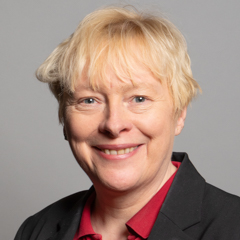
Dame Angela Eagle is the Labour MP for Wallasey, and has been an MP continually since 9 April 1992. They currently hold the Government post of Environment Secretary.
“I agree, and it is important for the hon. Lady to understand that we are integrating climate change risks into our work. The Department for Environment, Food and Rural Affairs is the leading Department on work on climate adaptation, not mitigation. It is important that lead Departments can focus on the issue at hand, and DEFRA is doing adaptation.”
Spoke in 45 debatesAsked 49 questions
National Defence
National Security (State Threats) Bill: Clause 2 - Offences relating to designated bodies
“We are very confident that the Bill as it is written does not place journalists in any jeopardy. In fact, these measures allow us to act against those who are conducting harmful activity in the UK, including targeting journalists here in the UK because of their attempts to expose activities in other regimes. The right hon. Gentleman makes a more general point about the jeopardy in which journalists put themselves in war zones, and I would agree that their news reporting is some of the bravest. We all support a free press and journalists’ ability to report in war zones, but I would say respectfully to him that these things are slightly different and he is combining the two issues. We are convinced that this Bill does not and will not put journalists in any more jeopardy in this country—certainly not for reporting. Baroness Northover tabled amendments 1, 2, 4 and 6 in the other place. They introduce a new defence into the offences at new sections 17B and 17C of the National Security Act 2023, specifically to cover legitimate humanitarian aid activity. This means that non-governmental organisations that have to engage with a designated body in order to carry out legitimate humanitarian activity will benefit from the same protections under the Bill as do UK diplomats. The Government also supported amendments 3 and 5, which were tabled by Lord Anderson. These amendments were based on the advice of Jonathan Hall KC and also had the support of Lord Carlile. They add a reasonable excuse defence in new section 17C of the 2023 Act for obtaining, accepting or agreeing to accept information from a designated body. This means that where a person has a reasonable excuse for receiving information from a designated body, they benefit from a defence. This might include, for example, a journalist conducting an interview or a charity receiving information on the location of landmines. The Government considered the case for exempting humanitarian NGOs from the offences, but we were advised by our operational partners that this would provide a loophole that hostile actors would seek to exploit, which in turn could make the NGOs themselves a target for infiltration. In fact, that is the case that I made to this Chamber in Committee. I am grateful to the other place and the International Development Committee for their engagement on this Bill and for the constructive amendments, which have helped strengthen the Bill and broaden its support. The Bill represents an important new addition to our toolkit to address the growing threat from foreign powers. As I said in Committee, my officials have worked closely with operational partners in the creation of this power and the accompanying offences, and our partners are fully supportive of the Bill. It closes a gap, and they have been explicit that it provides them with vital tools capable of addressing the sharpest threats that they are tackling.”
Spoke in 32 debatesAsked 5 questions
In Parliament
Selected from their parliamentary record
VOTED AYE20 Jun 2025
Terminally Ill Adults (End of Life) Bill
Commons division
VOTED NO8 Jan 2025
Reasoned amendment on Children's Wellbeing and Schools Bill