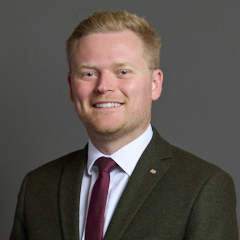
Josh Newbury is the Labour MP for Cannock Chase which covers the towns of Cannock, Hednesford and Rugeley and the villages of Bridgtown, Chadsmoor, Littleworth, Rawnsley, Hazelslade, Prospect Village, Cannock Wood, Brindley Village, Heath Hayes, Wimblebury, Norton Canes, Slitting Mill and Brereton.
Josh was first elected at the last general election on 4 July 2024. In Parliament, Josh serves on the Environment, Food and Rural Affairs Committee.
Environment, Food and Rural Affairs: Agri-tech Sector
“The Environment, Food and Rural Affairs Committee recently had the privilege of visiting New Zealand. We met an Innovate UK delegation promoting incredible British agri-tech innovations like cups that enable substrate-free hydroponics, vegetables that have 40 times the iron content, and AI analysis of drone, satellite and sensor data. Does the Secretary of State agree that agri-tech will be a key growth area for the UK? Will she work with counterparts in the Department for Science, Innovation and Technology and DBT to accelerate the success of British agri-tech start-ups?”
Spoke in 13 debatesAsked 25 questions1 APPG role
Healthcare
Health Bill
“Before becoming an MP, I worked in communications in our NHS. Combined with numerous stories from my constituents, that gives me a view of the NHS at its best, but also where things do not work as they should. Very few of our constituents think about the structures of the NHS. For them, whether it is working right comes down to whether they can see a GP and how long it takes to get a diagnosis and treatment. I welcome the Bill because all of us have constituents who have had to give the same information over and over, wasting their time and their clinician’s time and undermining trust in the fundamentals of a unified national health service. A member of my team told me about one of her family members who suffered a stroke two years ago. He got to A&E at 11 am, was diagnosed after several hours and then at 6 pm, after several scans, was told that he needed to travel to another hospital to see a specialist. When he got there, he was told that the data had not been passed across, so all those scans and tests had to be done again. Stories like that demonstrate why the single patient record made possible by this Bill is so vital for patients, who should not have to repeat their symptoms, and for clinicians, who want to focus on care. On the abolition of NHS England, the Government are right to shift money currently tied up in monolithic bureaucracy to frontline services. But as one of, I assume, very few former NHS communicators in this House, I want to dedicate the time I have left to them. The abolition of NHSE comes at a time when ICBs are shedding half of their staff and are busy clustering. It is a time of immense change and anxiety for staff. I have recently seen a slew of posts from brilliant NHS communicators who are signing off for the last time, or posting bittersweet celebrations of securing a role while many colleagues are leaving. Some see NHS communications jobs as a “nice to have”, but the reality is they are the people who ensure that patients, from general practice through to discharge, know how to get the right care at the right time. They are the ones who spring into action when the phone lines go down. They tell the stories of real people working and getting treated in our NHS, which is so vital to encouraging others to spot early warning signs and come forward. Comms in the NHS literally saves lives, and that is why when I see comms professionals leaving the NHS, I fear that we could be throwing the baby out with the bathwater through this important and justified process of change. I pay tribute to every NHS communicator, and I hope the Minister will say a little about how these legends will be valued and retained. The Bill will do so much to improve the NHS for millions of people in our country, so I will proudly support it, but let us ensure that we know the value of everyone who makes our NHS world-class.”