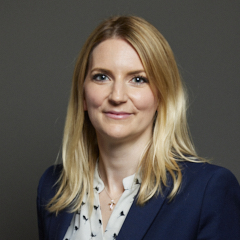
Julia Lopez is the Conservative MP for Hornchurch and Upminster, and has been an MP continually since 8 June 2017. She currently undertakes the role of Shadow Secretary of State for Science, Innovation and Technology.
Science, Innovation and Technology: Topical Questions
“I think the Secretary of State just said that the eminent professors are wrong. Aside from research spend, one of the core reasons for the budgetary pressures in physics is the ruinous cost of energy under Labour. It is ideology in research spend, and it is ideology in energy policy. In March, the Secretary of State said we need to sort out the problems facing physics funding as soon as possible; it is now July. Has she lobbied the Energy Secretary to stop him driving up the core costs of our critical scientific research institutions?”
Spoke in 19 debatesAsked 50 questions
Arts, Media and Sport
Social Media Ban for Under-16s
“I thank the Secretary of State for her statement. As someone infamous for her impatience, waiting for the Prime Minister to opine on something that she genuine cares about must have been as frustrating for her as it has been for us. Today the Prime Minister announced, as his shot at a legacy, something that six months ago he said he was personally opposed to—a ban on social media for under-16s. We can be grateful that he got there in the end, but the victory is not his. Thanks must go to some of the gutsier Labour Back Benchers whom we have heard cited today, the Leader of the Opposition, the shadow Education Secretary and, in particular, my noble Friend Lord Nash for his dogged determination in pursuing his amendments. Above all, we must thank those parents who took the senseless tragedies that befell their families and turned their pain into a legacy that will benefit so many children. They have conducted themselves with dignity and grace, and many are in the Gallery today to see the results of their courage. The Prime Minister’s about-turn tells many stories. If he were a man with views, his position could have been laid out at the start of the year, with the consultation used as a chance to polish the policy. As it is, officials’ heads have been left spinning trying to retrofit details to this damascene conversion. The Prime Minister likes to make a virtue of process, but he has used process in this case as a tool to avoid doing what so many hon. Members said was not only inevitable, but right and entirely necessary. We have had votes: the Prime Minister instructed his troops three times to vote against the ban. We have had debates: the Prime Minister would not give a view. But lo, a career-critical by-election comes along and, upon realising that protecting kids is not just popular but vital, the Prime Minister has finally found his voice. With Makerfield going to the polls on Thursday, perhaps we should use the next couple of days to maximum effect by trying to extract his opinions on funding defence, cutting welfare and getting cheap energy, because this country has been waiting for leadership for too long. As Conservatives, we believe in the ultimate responsibility of parents over their children, but they face huge challenges in keeping their children safe online. It is not simply a matter of denying them a phone or a computer. There are many good uses of tech that children and young people should be free to explore, but the onus is on us, as adults, to create a positive place for their exploration. Instead, activity that would never be tolerated in the real world has been normalised, monetised and algorithmically amplified, to the detriment of kids. The Online Safety Act 2023 was a step forward, but we better understand now that it is not just what children see, but how social media works. The success of the policy will depend heavily on its implementation, and the announcement still begs many questions. What additional resource is the Secretary of State giving to Ofcom? She is asking the regulator to take on a substantial amount of extra work. Does she expect tech companies to contribute more towards the regulator’s budget or will the funding come from her own budget? When can we expect precise definitions of what brings a platform into scope? A list of banned platforms has been briefed today, but it is not clear why some do not make the cut. Can the Secretary of State guarantee that this work will not distract from implementing the final stages of the OSA? What lessons has she learned from the circumvention of the Australia ban that will make the UK experience and our ban more effective? The Secretary of State talks about more effective age assurances, and I agree with her about the need to reset social norms, but will she be ruling out mandatory digital ID as a requirement for accessing social media? What privacy protections will be in place if children’s images are taken as part of face scanning for age verification? Is she considering age verification at app store level as a means not only of more reliable protection of children, but as a chance to reduce friction for adults wishing to access social media? The Government have said that they are considering overnight curfews and breaks in infinite scrolling for under-18s. How do Ministers square granting 16-year-olds the solemn duty to vote, but not the power to have a cheeky night-time scroll on Instagram? The same applies to romantic chat bots. How is this going to work? Will the restrictions apply to 16-year-olds or 18-year-olds, given that both meet the age of sexual consent? On efforts to prevent children from taking or sharing nude imagery, will the Secretary of State set out the scope of the law she is considering and categorically rule out client-side scanning tools being applied to adults’ phones? We are told that the first set of regulations to enable the social media ban could be in effect by spring 2027. How confident is the Secretary of State that she will achieve her timeline? She will understand that this policy is not easily implemented—she has made reference to that—and she has detractors who share the aim but not the means, fearing that a ban pushes children out of supervised accounts and towards riskier services. What does she say to those, like Ian Russell, who believe that this policy is not only wrong but cynically timed? She suggests that it comes down to enforcement of the OSA, which makes my earlier questions more relevant. Finally, I wish to ask the Secretary of State about her tweet last week on updating the Online Safety Act to remove illegal content with greater speed during “times of crisis”. The scenes in Belfast rightly appalled every decent citizen in our nation. The vicious barbarism of Hadi Alodid, just like the despicable murder of Henry Nowak, has ignited anger and sparked protests that have led to indiscriminate violence against innocent people. Violence and protest can often mix, but they are none the less two very different things. Laws exist that prohibit incitement, criminalise threats to kill and stop platforms from hosting illegal content, and they must rightly be enforced with strength. On the other hand, peaceful protest is a legitimate response to failure—in this case, the perceived failure of the political class to adequately deal with concerns that the public have raised time and again via the ballot box. In such circumstances, I appreciate that the Government have a job on their hands to ensure that work to stop the spread of illegal content is not perceived to be or does not become an attempt to obscure legitimate political comment. What powers are being taken? How will “times of crisis” be defined? What assurances can the Secretary of State offer the House that she understands that if the Government do not get their approach right, any actions she proposes risk stoking the very unrest that her policy is designed to subdue? For too long, we have implicitly decided that childhood and parenting must simply adapt to the darker manifestations of the internet as a reality of modern life. Giving parents the support that they need is not the same as the state stripping them of their ultimate responsibilities, but when harm from social media to our children is real and growing, the time comes for action, even when the answers are not perfect. I look forward to working with the Secretary of State on ensuring that the implementation of her policy is as close to perfect as it can be.”