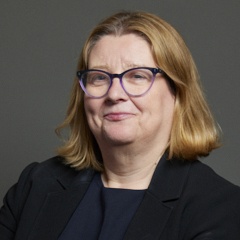
Katrina Murray is the Labour MP for Cumbernauld and Kirkintilloch, and has been an MP continually since 4 July 2024.
Percentage of votes
45.18%
Winning margin
10.11%
Recent swing
+18.1% Labour
Party
Labour
Top donors:
Latest from Katrina in parliament
Filter by topic
Business and Trade
Des Loughney and the Edinburgh Trade Union Council
“I draw attention to my entry in the Register of Members’ Financial Interests as co-chair of the Unison group of Labour MPs. For too long, many workers have been expected to keep themselves available for work without any certainty over the hours or income that they would receive. The right to guaranteed hours was designed to change that. As those provisions are implemented, what practical difference does the Minister expect they will make to working people across the country?”
Backed 1 motionSpoke in 21 debates
Government Finances
Northern Ireland Office
“I will do my best on that score, Madam Deputy Speaker. I congratulate my hon. Friend the Member for Gower (Tonia Antoniazzi) on securing this important debate. I want to draw on a consistent message that the Northern Ireland Committee has heard throughout a number of inquiries, whether into public services, the Northern Ireland economy, or police and security: the recurring question about whether the Northern Ireland Executive have been given sufficient funding to deliver the public services that people rightly expect. I know that am looking at that question from an interesting perspective—that of an MP whose constituency is not on the island of Ireland, and who is not directly affected by the day-to-day machinations and interdependence of relationships between the Northern Ireland Office, the Treasury, this place, the Northern Ireland Executive and the Assembly—but as a Scottish MP, I do understand the practical realities of devolution. Week in, week out, I see the impact of different political priorities being pursued by different Governments with the resources available to them. We always say we do not have enough money, but we will never have enough money; we always want more money. And that experience has shaped how I view this debate. The Committee has considered in depth the evidence of the Northern Ireland Fiscal Council, recognising that Northern Ireland’s unique circumstances means that it requires more funding than a simple Barnett consequential. I keep coming back to the fact that the council again concludes that funding at around 124% of comparable spending in England is appropriate. It is considerably better than sticking a finger in the air and thinking of a number. The spending review reflects that assessment. The Executive will receive an average of £19.3 billion a year over the spending review period, alongside targeted investment in public service transformation, policing, and city and growth deals. That is not to dismiss the very real pressures on Northern Ireland’s public finances. But funding alone is not enough if public services are unable to plan because the Executive have yet to make the decisions needed to allocate that funding. Tomorrow is the last day of June—the end of the first quarter of the 2026-27 financial year—and the Northern Ireland Executive still have not agreed a single-year budget, let alone a multi-year one. That matters because budgets are not simply accounting exercises. They allow hospitals to plan, schools to recruit, police services to invest and public services to provide certainty for the people they serve. The consequences of delay are not abstract; they affect real people. I draw the House’s attention to my entry in the Register of Members’ Financial Interests, as one of the chairs of the Unison group of Labour MPs and someone who has been a member of Unison for 30 years. Before my time in this place, I lived this issue. When the Assembly collapsed in 2022, health workers in Northern Ireland received no pay increase because there was no functioning Executive able to implement the recommendations of the independent pay review body. The eventual award had to be backdated at the end of the financial year. The consequences were significant: employers had to take action to ensure that staff were not inadvertently paid below the national minimum wage; payroll teams faced complex manual calculations to recover interim payments once backdated awards were made; and, for many low-paid NHS staff members who were also in receipt of universal credit, it created unnecessary financial uncertainty and administrative complications, because a year’s backdated money in one pay packet is not an indicator of regular income. It was unfair on staff, inefficient for employers, and, ultimately, patients paid the price when public services could not plan with certainty. This was not a one-off. It has happened four times in the past five years, regardless of whether or not Stormont has been sitting. I know that the hon. Member for South Antrim (Robin Swann), in his life before this place, did his best to try to get it through, and that is recognised and known. But it is not acceptable. This year, the “Agenda for Change” trade unions have been told that there will be no uplift until a budget has been agreed. That means that, once again, there have been manual calculations to ensure that people are not being paid below the national minimum wage. We need to do more about that. Northern Ireland does receive funding above its independently assessed level of need. There have been levels of growth deals—defence growth deals, and city and growth deals, with the need to invest in apprenticeships —so the opportunity is there. The question is not simply about whether there is enough money; it is about whether the decisions are being taken to use that money effectively. The priority must be for the Executive to agree a budget —preferably a multi-year one—to give public services the certainty they need. Long-term planning ensures that significant investment delivers tangible improvements for the people of Northern Ireland. I therefore ask the Minister what further discussions he is having with the Executive to encourage agreement on a multi-year budget so that this record settlement can be translated into the public services and better outcomes that the people of Northern Ireland deserve, because they deserve nothing less.”