FAQsTermsPrivacyContact
State Logo
StateConstituenciesRepresentative
Back to Salford
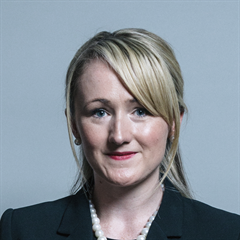
Rebecca Long Bailey

Rebecca Long Bailey

Labour MP for Salford

Rebecca Long Bailey is the Labour MP for Salford, and has been an MP continually since 7 May 2015.

Share
Website

Seat status

Very safe

Percentage of votes

38.03%

Recent swing

-4.2% Labour

Party

Labour

Top donors:

National Union of Journalists (£19,606)

Bakers, Food and Allied Workers Union (£19,440)

National Union of Journalists (NUJ) (£18,672)

Share donors

Explore what Rebecca is advocating for

Filter by topic

Benefits and Jobs

Pensions Update 29 January 2026 on the PHSO Report Response

“I speak in support of new clause 4, tabled by my right hon. Friend the Member for Hayes and Harlington (John McDonnell), me and others, and I will try to be as brief as I can. Scrapping the two-child limit in full remains the single most impactful step we can take to reduce child poverty, and will lift 450,000 children out of poverty by 2030. When combined with other measures in the child poverty strategy, more than 550,000 children will be lifted out of poverty by the end of the decade. Some Members of this House have said, “How can the country justify this multibillion-pound spend?” It is around £3 billion a year, but child poverty costs the UK economy £39 billion annually—more than 10 times as much. That £39 billion reflects poorer health, lower educational attainment, increased pressure on public services and lost economic potential. Investing £3 billion to reduce a £39 billion problem is not reckless spending; it is a highly targeted, cost-effective investment with long-term returns. It is preventive policy at its very best. Other Members have asked why taxpayers should support larger families. Well, the honest truth is that only a very small number of families have more than four children, and almost all are working hard to provide for them. The two-child limit has had no measurable impact on family planning and has not influenced fertility rates; it simply punishes children who are already here. Every child, regardless of birth order, deserves enough food, a safe home and a fair start in life. When children are supported to thrive, they do better in school, stay healthier and contribute more fully as adults, and that benefits all of us. Those who argue that support should not go to families out of work should remember that six in 10 children affected by the two-child limit live in households where at least one parent works, and those families are taxpayers too. As my mum says, there but for the grace of God go I. A crisis can happen in an instant at any moment, and bereavement, illness, redundancy or family breakdown can push any household into temporary reliance on universal credit. A humane and flexible social security system exists to provide stability in those moments of crisis. I urge all Members to support the passage of the Bill today, but it must be just the start and we must go further. Alongside scrapping the two-child limit, we have to address the wider benefit cap, which was introduced in 2013. It has bored down on the backs of many families like a rucksack full of lead. Organisations including the Child Poverty Action Group, the End Child Poverty Coalition, Save the Children UK, the Children’s Society, Barnardo’s, Action for Children and the Joseph Rowntree Foundation have all highlighted the damaging impact of the overall cap. It places arbitrary ceilings on support, regardless of rent levels, local costs or family size. It disproportionately affects single parents—overwhelmingly women—and families in high-cost areas. It drives rent arrears, temporary accommodation and homelessness, and the evidence is clear that it does not meaningfully increase employment; it increases hardship. If we are serious about tackling structural poverty, we cannot remove one barrier while leaving another firmly in place. Lifting the overall benefit cap would complement the removal of the two-child limit, ensuring that the gains we make today are not clawed back through arbitrary ceilings that fail to reflect real living costs. I applaud the Government for scrapping the two-child cap, which is the right thing to do, but I hope that the Minister can give us some assurances that his next step will be to look at lifting the benefit cap.”
Signed 1 open letterBacked 2 motionsSpoke in 27 debatesAsked 21 questions1 APPG role

Energy

Nuclear Test Veterans

“The hon. Lady has been a doughty campaigner on behalf of her own party on this issue and I thank her for her work in this House. She is right. The veterans are not asking for special treatment; they are just asking for the truth and for justice. Many of these men, if they are lucky enough to still be alive, are in their 80s. Time is running out for them and they need justice now. That is why it is so important to have the urgent one-year inquiry. I will return to that point later. I want us to look at the lived reality for those servicemen at Christmas Island. The men fished daily—that is known. They ate that fish, sometimes every day. They drank desalinated water drawn from a marine environment now known to have been contaminated. They worked in extreme heat, increasing their intake of water and food—as we do, when we get hot—and therefore increasing the pathways through which radioactive material could enter their bodies. This is the critical point: ingested radiation is not the same as background exposure. It does not simply pass by. It lodges deep within the body. It decays slowly. It damages tissue. It alters DNA. Governments over the years have long relied on averages and on comparisons to natural background radiation, sunlight or medical imaging, but those comparisons are fundamentally flawed. You can step out of sunlight if it is too hot. You can leave a room that has radon gas in it. You can decline a medical scan if you are worried about it. But you cannot remove radioactive particles that have been ingested and embedded deep within your body. That distinction matters, but it has been completely ignored over the years. What is equally troubling is not just the existence of this data, which has been around for decades, but the pattern of its concealment. This information could have been disclosed at multiple points: in the 1950s, during the inquests into early deaths; in the 1980s, when public concern first intensified; in the 1990 and 1993 reports; in proceedings before the European Court of Human Rights; in High Court cases; in pension appeals; and as recently as 2024, when veterans sought access to their medical records. At every stage, the same narrative was maintained. At every stage, the data was absent. The 2014 report itself warned that the information could “challenge the validity of statements” made by the Government and could potentially overturn previous judicial decisions. And yet instead of coming clean and that information being published, it was buried. We have got to ask ourselves, why? Why was a report that raised “reasonable doubt” not disclosed to the very people whose lives depended on its findings? Why were veterans denied access to information that could have supported their claims for justice and compensation? Why were the courts allowed to rely on evidence that we now know to be fundamentally flawed? These are not abstract questions—they go right to the heart of trust between the state and those who serve it. The men and women in uniform sent to carry out dangerous duties do so on the understanding that their Government will act with honesty, transparency and integrity. That trust has been broken, and we now have a duty—not just a moral duty, but a political and legal duty—to put this right. Let me be clear about what the Government must do next. First, there must be a full, independent public inquiry into the handling of radiation data from the nuclear testing programme—not a limited review or an internal investigation, but a full inquiry with the power to compel evidence and testimony. Secondly, all relevant documents must be declassified and placed in the public domain—no more partial disclosures and work in progress justifications; the public interest in transparency far outweighs any institutional discomfort. Thirdly, there must be a comprehensive review of all past legal cases and pension decisions that relied on the 1990 and 1993 reports. Where decisions were made on the basis of incomplete or inaccurate evidence, they must be revisited. Fourthly, and most importantly, there must be a fair and just compensation scheme for nuclear testing veterans and their families.”

Spoke in 11 debatesAsked 9 questions
Share advocacy

Latest from Rebecca

Recent posts pulled from their website

Rebecca Long-Bailey backs cuts tax on household electricity bills

Blog · 21 Jul 2026

Summer newsletter

Blog · 17 Jul 2026

Rebecca Long-Bailey MP welcomes Salford veteran for LGBT Restorative Action presentation in Parliament

Blog · 23 Apr 2026

Key Parliamentary Votes

See where your MP stands on these issues

VOTED AYE4 Sep 2025

House of Lords (Hereditary Peers) Bill

✓ Passed — 336 For, 77 Against

DID NOT VOTE9 Mar 2026

Children's Wellbeing and Schools Bill

✓ Passed — 307 For, 173 Against

DID NOT VOTE10 Mar 2026

Courts and Tribunals Bill

✓ Passed — 304 For, 203 Against

Where Rebecca fits into things

Sir Keir Starmer

Sir Keir Starmer

Prime Minister

Rebecca Long Bailey

Rebecca Long Bailey

Labour MP for Salford

Surgeries

Monthly in-person, occasional online

Examples of successful citizen influence

  • Coordinated constituent emails leading to parliamentary questions
  • Local campaign prompting a public statement

Pressure that tends to influence

  • High volume constituent contact
  • Media attention on local issues
  • Cross-party committee pressure