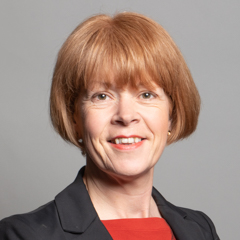
The Rt Hon Wendy Morton is the Conservative MP for Aldridge-Brownhills, and has been an MP continually since 7 May 2015. She currently undertakes the role of Shadow Minister (Foreign, Commonwealth and Development Office).
“Absolutely not. I stand here not as a Brexiteer, but as somebody who was a reluctant remainer. I voted for remain partly because of the security of our country, but let me tell the hon. Gentleman that there is no way that I regret that decision. I am a pragmatic Brexiteer—like most of our country—but it is no good him standing there and bemoaning this, that and the other; the decision about the defence investment plan falls on his Government. If it is such a good idea, what has stopped them—I notice the Government Benches are empty—just getting on and delivering it for the sake of our country?”
Spoke in 20 debatesAsked 12 questions
Business and Trade
Opposition Day: Summer Jobs
“It really was, but it was more than that. It got me used to the whole mindset of going to work: getting up, being there for a certain time, and asking, “Is there anything else I can do?” My job was waitressing, and the usual pot-washing. Alongside that, when I was old enough, I learned how to pull a pint. My sister did the same, as did other youngsters from our village and the local towns. The employer was fantastic; he would pick up those who did not have transport and whose parents could not take them, and he made sure they got home as well. To me, that was a responsible employer. That job gave me confidence. I was forced to speak to people in a restaurant environment, and had to handle cash and bookings—really important skills. The biggest skill of all was feeling confident that I could go out and work. We talk about working people; I very much think that the Conservative party is the party of working people. We have outnumbered Labour Members in this debate. When I was growing up, there was always an expectation that we would go through education and then go out to work. If we wanted something, we worked for it. That was the way that we were brought up. Today’s debate has highlighted something quite sad: young people today do not have the same number of opportunities to get a summer job. This is about gaining not just money, but experience. I speak to so many employers, and have done for some time, about the importance of employability. Too often, I hear that employers small and large want to take on young people, but those young people do not have all the skills. That is not their fault; it is because they have not had the summer job, or a newspaper round or whatever, which helps that little bit when starting a job. We need to take a long hard look at the employment market, and we need to look at what has happened in the last couple of years. We have heard today that youth unemployment is running at 14.5% for 18-to-24 year olds, up from 12% in 2024. Youth employment for those aged between 16 and 17 is at a staggering 30%, up from 24.7%. I read that 700,000 graduates are out of work and claiming benefits. There is something wrong there. We encourage young people to go through education and to go to university, and then they struggle to find employment. That is partly because unemployment is high, but it is also because of the burdens being placed on our businesses. We talk a lot about large businesses, but often, the SMEs and the micro-businesses—the lifeblood of local communities and high streets that I have the pleasure of representing across Aldridge Brownhills—are being buried in red tape. They have seen employers’ national insurance hiked, they are being blocked from employing under-16s, and they are suffering as a result of high energy costs. Any business that we go to will talk about the hike in energy costs, and for an energy-intensive industry, that hike is particularly difficult. In my constituency, we have a lot of brick makers; in the west midlands, brick making and the ceramics industry are really important. Although Denby is not in my constituency, who does not like picking up a piece of Denby pottery and seeing “Made in England” proudly stamped underneath? We are losing those businesses, which means that we are losing opportunities for young people, the opportunity to grow our economy and develop more skills, and our manufacturing capability, which is important. We saw during covid how important it was to have sovereign, UK-based manufacturing capacity and capability when we needed to manufacture the critical covid vaccines. That surely should have taught us something. We have to build up more home-made skills. I also urge the Government to look at skills and opportunities for young people and, more broadly, at what skillset we need for today and for the future. We talk about the opportunities that artificial intelligence will bring, but it will also bring challenges to some sectors. The big question is: are we ready for that? I do not think that we have done nearly enough thinking to get us to that point. We have to do that now, to make sure that we are developing the right skills. For years, people who did an apprenticeship in engineering or plumbing were seen as not earning as much as the graduates who had been to university and got the high-tech jobs. There were also the toolmakers—[Laughter.] We can laugh about toolmakers, but in the west midlands there is a history of toolmaking. My point is that AI will not be able to replace all those skills. We need to look at what we need in future, and our education system—our schools, universities and colleges—need to make sure that we are all working together. Critical to that conversation is business, and not just big business. I come back to my point about small business. We started our business many years ago with something called enterprise allowance. My husband had an idea, and the enterprise allowance paid us £40 a week. It did not seem like much at the time but, my goodness, we felt that the Government were backing us to create an income, a living and a business. We need much more backing and confidence for our business community. It is time that we created a culture that supports businesses—one where “business” is not the bad word. Business is not bad. It is not bad to make a profit, because that profit is so often put back into the business, into employment and into the young people who, we all agree, we want to nurture and encourage, so that they can get into employment, get a job and a skill, and have a bright future.”
Spoke in 16 debatesAsked 9 questions
In Parliament
Selected from their parliamentary record
VOTED NO20 Jun 2025
Terminally Ill Adults (End of Life) Bill
Commons division
VOTED AYE8 Jan 2025
Reasoned amendment on Children's Wellbeing and Schools Bill